How many bags of concrete do you need per cubic foot?
Usually concrete mix bags are sold in bags of 40lb, 60lb or 80lb.
1 cubic foot requires 3.34 bags (round to 4) of 40lb of concrete mix.
1 cubic foot requires 2.22 bags (round to 3) of 60lb of concrete mix.
1 cubic foot requires 1.67 bags (round to 2) of 80lb of concrete mix.
Therefore we can apply the following matrix to calculate the number of bags of concrete needed per volume of slab.
| 40lb bag | 60lb bag | 80lb bag | |
| 1 ft3 | 4 | 3 | 2 |
| 10 ft3 | 34 | 23 | 17 |
| 20 ft3 | 68 | 45 | 34 |
| 50 ft3 | 170 | 112 | 85 |
| 100 ft3 | 340 | 223 | 170 |
For example, if you need to build a slab with a volume of 50 ft3, you will need 170 bags of 40lb bags of concrete mix.
You can also use our calculator to assess how much it would cost you if you enter the price for each type of concrete bags at your local supplier.
How much money do you need to purchase enough concrete to build a slab ?
1x 40lb bag of concrete costs ~ $5.00 USD
1x 60lb bag of concrete costs ~ $5.75 USD
1x 80lb bag of concrete costs ~ $6.25 USD
In Canada, concrete mix is usually sold in 30 kg bags (about 66 lb) rather than 40, 60 or 80 lb bags. A standard 30 kg bag costs roughly $7 to $10 CAD at retailers such as Home Depot Canada. Prices vary by region, so enter your local supplier's price in the calculator for an accurate total.
| 40lb bag | 60lb bag | 80lb bag | |
| 1 ft3 | $20 | $17 | $13 |
| 10 ft3 | $170 | $132 | $106 |
| 20 ft3 | $340 | $259 | $213 |
| 50 ft3 | $850 | $644 | $531 |
| 100 ft3 | $1,700 | $1,282 | $1,063 |
Calculating Volume for Round Slabs or Round Columns (cylinder shape):
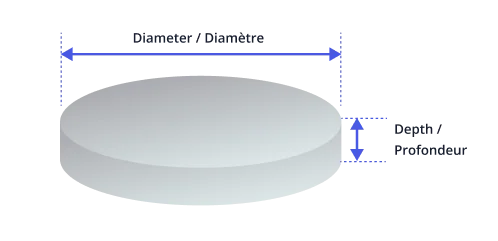
For round structures like round slabs or columns, you'll use the formula for the volume of a cylinder. Here's how to calculate it:
1. Measure Diameter or Radius: Measure the diameter (the distance across the center) of the round structure, or if you have the radius (half of the diameter), use that measurement. Ensure you use consistent units, such as feet or meters.
2. Measure Depth: Measure the depth or thickness of the concrete you want to pour. This is typically measured in inches or centimeters.
3. Apply the Formula: Use the following formula to calculate the volume in cubic feet or cubic meters:
- If using diameter: Volume (cubic feet or cubic metres) = π x (Diameter/2)^2 x Depth
- If using radius: Volume (cubic feet or cubic metres) = π x Radius^2 x Depth
Here, π (pi) is approximately 3.1416.
4. How to calculate yards of concrete ? If you prefer to work with cubic yards, you can convert the result by dividing the cubic feet by 27, as 1 cubic yard equals 27 cubic feet.
If you want to convert cubic metres to cubic yards, multiply cubic metres by 1.308, as 1 cubic metre equals 1.308 cubic yards.
- Volume (cubic yards) = Volume (cubic feet) / 27
- Volume (cubic yards) = Volume (cubic metres) x 1.308
Calculating Volume for Square Slabs, Square Columns, Walls or Footings:
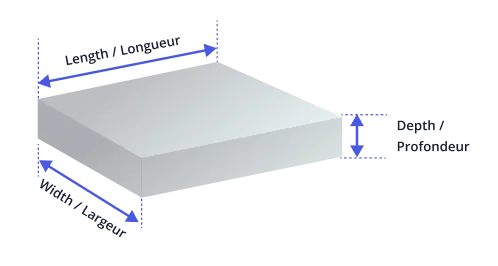
For square or rectangular structures like slabs or columns, you'll use the formula for the volume of a rectangular prism (a box-like shape). Here's how to calculate it:
1. Measure Length and Width: Measure the length and width of the square or rectangular structure in feet or meters. Ensure you use consistent units for both measurements.
2. Measure Depth: Measure the depth or thickness of the concrete you want to pour. This is typically measured in inches or centimeters.
3. Apply the Formula: Multiply the length, width, and depth together to calculate the volume in cubic feet or cubic meters:
- If using feet: Volume (cubic feet) = Length (feet) x Width (feet) x Depth (feet)
- If using meters: Volume (cubic meters) = Length (meters) x Width (meters) x Depth (meters)
4. Convert to Cubic Yards: If you prefer to work with cubic yards, you can convert the result by dividing the cubic feet by 27.
- Volume (cubic yards) = Volume (cubic feet) / 27
- Volume (cubic yards) = Volume (cubic metres) x 1.308
Frequently Asked Questions
How many 80lb bags of concrete do I need for a 10x10 slab? For a 10x10 slab at 4 inches deep you need approximately 1.23 cubic yards of concrete, which equals roughly 56 bags of 80lb concrete.
How many bags of concrete are in a cubic foot? One 80lb bag yields approximately 0.60 cubic feet. One 60lb bag yields approximately 0.45 cubic feet.
What is the difference between concrete and cement? Cement is an ingredient in concrete. Concrete is made by mixing cement, water, sand, and gravel. You cannot use cement alone as a structural material.
How thick should a concrete slab be? A standard residential slab is 4 inches thick. Driveways are typically 6 inches and high-load areas may require 8 inches or more.
How do I calculate cubic yards of concrete? Multiply length by width by depth in feet, then divide by 27 to convert cubic feet to cubic yards.
How long does concrete take to cure? Concrete reaches 70% of its strength within 7 days and full strength at 28 days. Avoid heavy loads for at least 7 days after pouring.
How many bags of concrete are in a yard? One cubic yard is 27 cubic feet, so it takes about 45 bags of 80lb concrete, 60 bags of 60lb concrete, or 90 bags of 40lb concrete.
How much does a yard of concrete weigh? A cubic yard of standard concrete weighs about 4,000 lb, or roughly 2 tons. In metric, concrete weighs about 2,400 kg per cubic metre.
How many square feet does a yard of concrete cover? At 4 inches thick, one cubic yard covers about 81 square feet. At 6 inches thick, it covers about 54 square feet.
How do I calculate concrete in cubic metres? Multiply length by width by thickness, all in metres. For example, a 3 m x 3 m slab that is 10 cm thick needs 0.9 cubic metres of concrete.
How many bags of concrete do I need per fence post? It depends on the hole size. A 10-inch-wide hole that is 3 feet deep holds about 1.6 cubic feet, which is roughly 3 bags of 80lb mix, slightly less once the post is in.
How do I calculate concrete for a footing or sonotube? Use the cylinder formula: π x radius² x depth. For example, a 12-inch sonotube 4 feet deep holds about 3.14 cubic feet, which is just over 5 bags of 80lb mix, so buy 6.
When should I order ready-mix instead of bags? Bags are usually practical for jobs under about 1 cubic yard (around 45 bags of 80lb mix). Above that, ready-mix delivered by truck is faster and more consistent. Many suppliers charge a short-load fee on small orders, so compare both options.
How much extra concrete should I order? Order 5 to 10% more than your calculated volume to cover spillage, uneven ground and form movement. Running short in the middle of a pour costs far more than a little leftover concrete.
How many yards does a concrete truck hold? A standard ready-mix truck carries about 8 to 10 cubic yards (roughly 6 to 7.5 cubic metres). Capacity varies by truck and local weight limits, so confirm with your supplier.
Can you pour concrete in cold weather? Yes, with precautions. Protect the concrete from freezing until it reaches about 500 psi, usually within the first 24 to 48 hours. Never pour on frozen ground, and use insulated blankets, heated water or a set accelerator when temperatures drop below 5°C (40°F).