

Construction Software in the Agentic AI Era
As general contractors, you have been sold software your whole career. Take-off software. Estimating software. Project management software. Accounting software. Each one promised to make your life easier. And to be fair, most of them did.
Spreadsheets got replaced. Paperwork moved to the cloud. Your crew could see the schedule from their phone. But here is what never changed: the software still needed you to run it.
You still had to build the estimate. You still had to check the dashboard. You still had to call the client back. You still had to follow up with the lead that came in while you were on site. The tools got better. The workload did not.
That is the problem the agentic AI era is here to solve.
What agentic AI actually means in plain language, why construction is one of the industries where it matters most, and what AI-native construction software looks like for a GC in the real world.
Think about the construction software you use today. You log in. You enter data. You review dashboards. You generate reports. You send invoices. The software gives you a place to do all of that more efficiently than paper would. But who is doing the work? You are.
The software is organized. The software is searchable. The software is shareable. But it sits there waiting for you to use it. It does not go out and do anything on its own. It is a better filing cabinet, not a team member.
That has been the reality of every era of construction software, from the first digital estimating tools in the nineties to the cloud platforms of the last decade. Look at the pattern:
| Era | What the software did | What you still had to do |
|---|---|---|
| Spreadsheets | Stored your data | Everything |
| First-gen software (2000s) | Structured your data | Still everything |
| Cloud software (2010s) | Shared your data in real time | All decisions and actions |
| Agentic AI (2026) | Acts on your data. Handles tasks. Works while you work. | What genuinely needs your judgment |
Notice the last column. It barely changes. The software got dramatically better at storing, structuring, and sharing your data. What you had to do with that data stayed mostly the same. Agentic AI is the first real break in that pattern.
Agentic comes from agent, as in something that acts. Agentic AI does not just sit there waiting to be asked a question. It takes action. It handles tasks. It operates inside your business while you are running a job site.
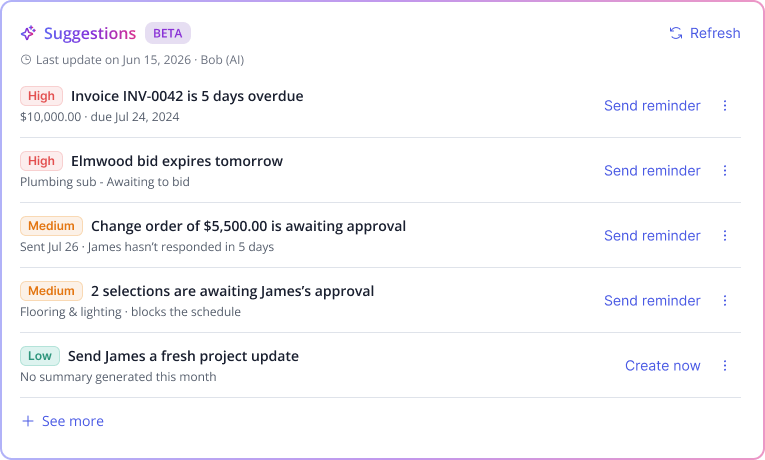
Assistive AI: you prompt it, it responds. You ask it to draft an estimate, it drafts one. You ask it what is happening on a project, it tells you. Useful, but it needs you to initiate everything.
Agentic AI: it operates toward a goal without waiting to be asked. It handles the estimate because that is its job. It flags a scheduling issue because it is already watching. It follows up with the lead because that is what it does.
For a GC managing five active jobs, two subs who have not confirmed, a client waiting on a progress report, and a lead that came in yesterday, the difference between those two models is enormous. Assistive AI helps you when you have time to use it. Agentic AI works while you are busy doing everything else.
Enough theory. Here is what the shift from assistive to agentic actually looks like in the day-to-day of a construction business.
Before: You spend two to three hours building a quote from scratch. You look up current material prices. You format the proposal. You email it as a PDF and wait for feedback.
After: The AI builds a detailed estimate from your actual price book and your past jobs in minutes. You review it, adjust if needed, and send. The client reviews and signs through their dashboard. The whole process takes a fraction of the time.
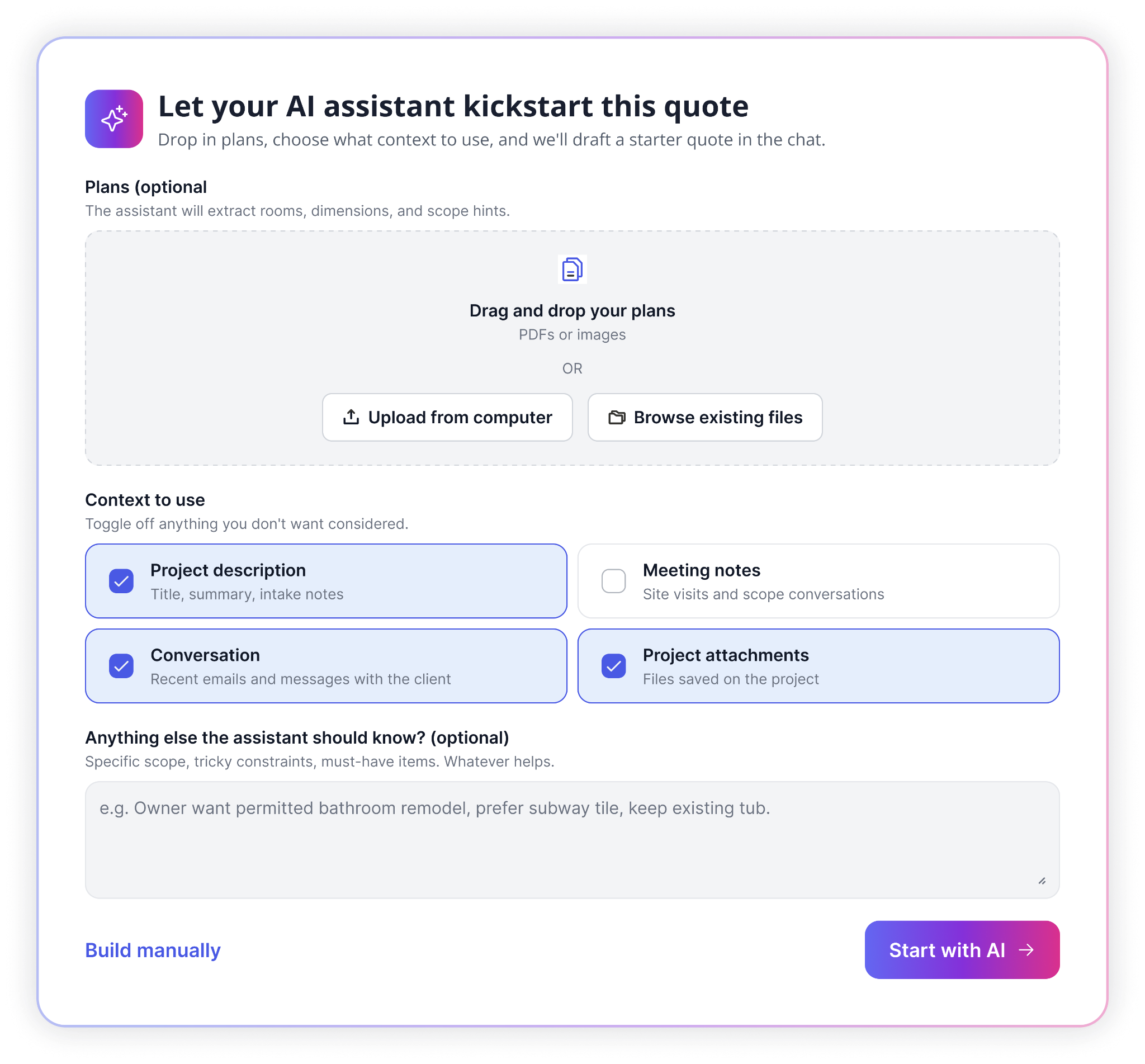
Start a quote the way you'd brief a new estimator: drop in the plans, tell it what to pay attention to, and let it build the first draft.
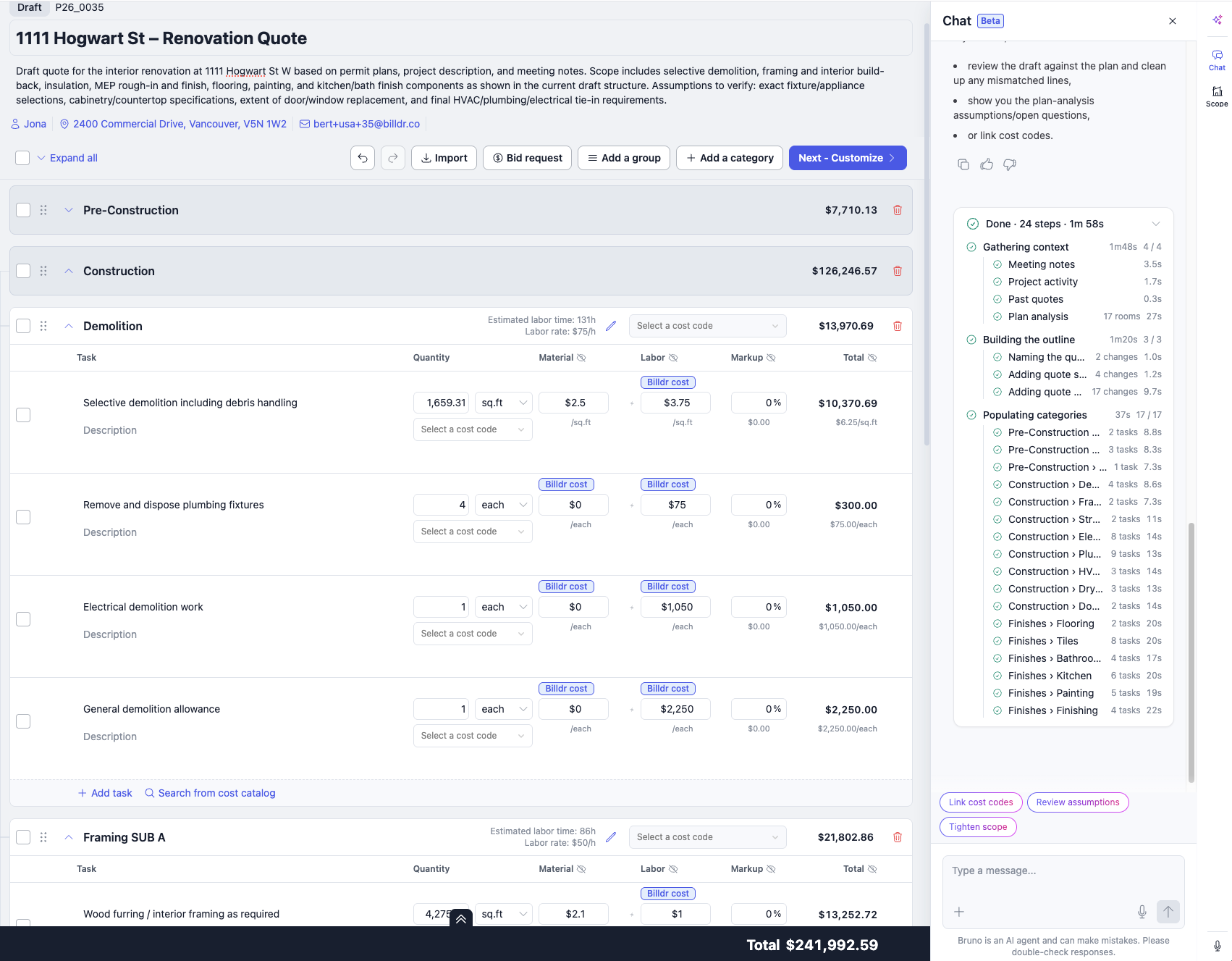
We split the screen because trust requires two different things: a real, directly-editable quote (left) and full visibility into how Bruno got there (right).
GCs do not trust a number on a quote they cannot audit. So instead of a spinner, we expose Bruno's actual step trace: which plans it read, which past quotes it pulled, which categories it built. That is what lets a GC catch the one wrong line instead of redoing the whole estimate. Chat stays live so GCs can iterate with Bruno continuously. "Link cost codes," "Review assumptions," "Tighten scope" are the real next moves an estimator makes after a first pass. Bruno is not done when the quote is generated. It is done when the GC is done.
Before: You review your project dashboards every morning to figure out what needs attention. Half the time you find out about a problem because a client called you.
After: Your platform monitors every active job in real time. Instead of digging through dashboards to find the problem, the right information comes to you. You spend your time solving things, not hunting for them.
Before: A lead comes in at 8pm while you are at dinner with your family. You see it at 9pm. By the time you follow up the next morning, they have already called three other contractors.
After: The lead gets a response right away. It is qualified, a call gets booked into your calendar, and if they do not respond, a follow-up goes out automatically. You wake up with a scheduled call on your calendar.
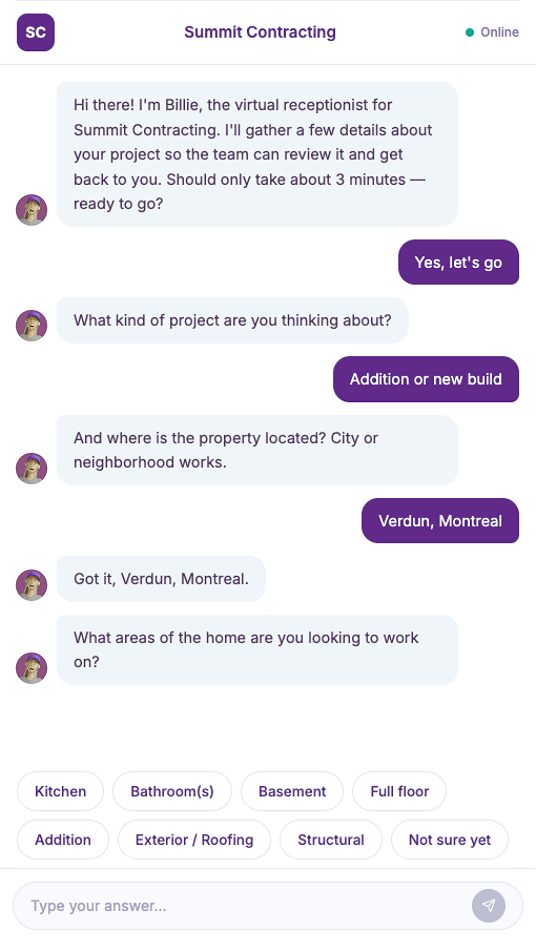
Billie qualifying a lead in real time: project type, location, and scope, gathered in a two-minute chat instead of a game of phone tag.
These three things are connected. Faster estimating means you can bid on more jobs. Fewer missed leads means a stronger pipeline. Better operational awareness means fewer overruns eating your margin. Fix all three at once and you are not making incremental improvements. You are running a fundamentally different business.
Most construction platforms are not built for the agentic era. They are built for the cloud era, and they are now trying to add AI on top of that. There is a meaningful difference between a platform that was designed with AI as part of how it works and one that connected an AI tool to an existing system.
Think of it like this: it is the difference between a truck built for off-road and a regular car with bigger tires put on it. Both can drive on rough terrain. Only one was designed for it.
When you are evaluating construction software in 2026, the question worth asking is not just whether the platform has AI. It is whether the AI is embedded in the workflow from day one, or whether it is an add-on that requires its own subscription, its own setup, and your own time to prompt every time you want something done.
Purpose-built AI knows your price book. It knows your cost codes. It understands how a construction project actually runs. General-purpose AI connected to your data knows how to write emails.
A harness connects you safely to the power of AI agents and keeps you in control of the work being performed autonomously. For a GC, Billdr is the harness that connects you to agentic AI without requiring you to understand how it works underneath. You can configure those AI agents intuitively to interact with your construction software, prompt them manually, or program them to execute recurring tasks (Routines) within your environment.
GCs are not AI researchers or software developers. They are builders, project managers, and business owners who need to win work, deliver projects, and get paid. The harness creates an intuitive environment for GCs to coordinate their AI workforce. You get the output of AI without the complexity of learning how to code in a terminal.
Central to the Billdr harness is a library of Routines — for example, every day at 5pm summarize all daily logs received, every Monday morning run a report of accounts receivables or payables over 14 days. Think of Routines as the pre-built AI workflows that your AI team runs on your behalf: construction-specific, ready to activate, and requiring no setup.
Routines are pre-built AI workflows designed specifically for how construction businesses operate. Think of them as the playbook your AI team runs on your behalf.
You activate the Routines that fit your business. Your AI team executes them consistently, automatically, without you having to initiate anything. The more Routines you run, the more of your operational load gets handled without your direct involvement.
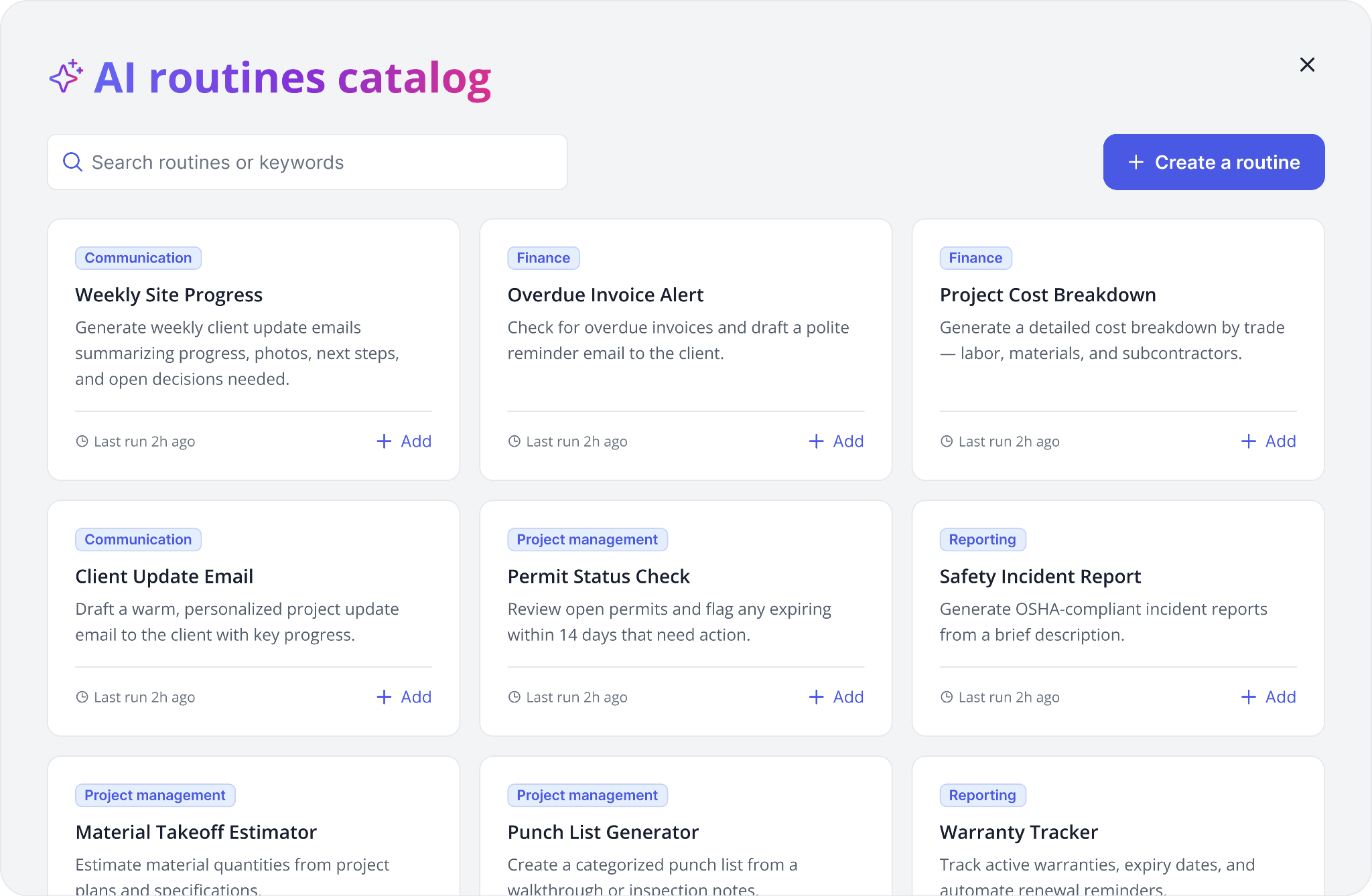
Billdr's AI team is where the harness connects to actual output. Each team member handles a specific part of the operational workload that currently lands on you.
Bob monitors every active project in real time, flags issues before they compound, and answers questions instantly without you having to dig through dashboards. Bob is also where Routines live — your library of pre-built AI workflows that run automatically on your behalf.
Activate a Routine and Bob handles the execution. The more Routines you run, the less operational overhead lands on your plate.
The output is a professional construction scope of work ready to send to the client. The more you use Bruno, the more it learns your cost structure and the more accurate it gets.
Bid more opportunities without adding estimating headcount.
When a homeowner submits an inquiry at 9pm, Billie responds within minutes, qualifies the project scope, and books a call into your calendar. You wake up with a qualified lead rather than an unread email. Billie is currently in development and coming to Billdr soon.
None of this requires you to be at a desk. Bob, Bruno, and Billie live in the Billdr app on your phone, the same place you already check your schedule and snap job site photos.
You are standing in a half-framed kitchen when a sub asks about a change order. You pull out your phone, ask Bob what needs your attention today, and get an answer before the conversation moves on.
A homeowner calls while you are driving between sites, so you pull up Bruno's estimate at the next red light instead of waiting until you are back at a computer.
The office was never really the problem. Your job has always happened on-site, in your truck, between calls. Software that only works when you are sitting down was built for a version of your day that does not exist. Billdr's AI team goes wherever you go.
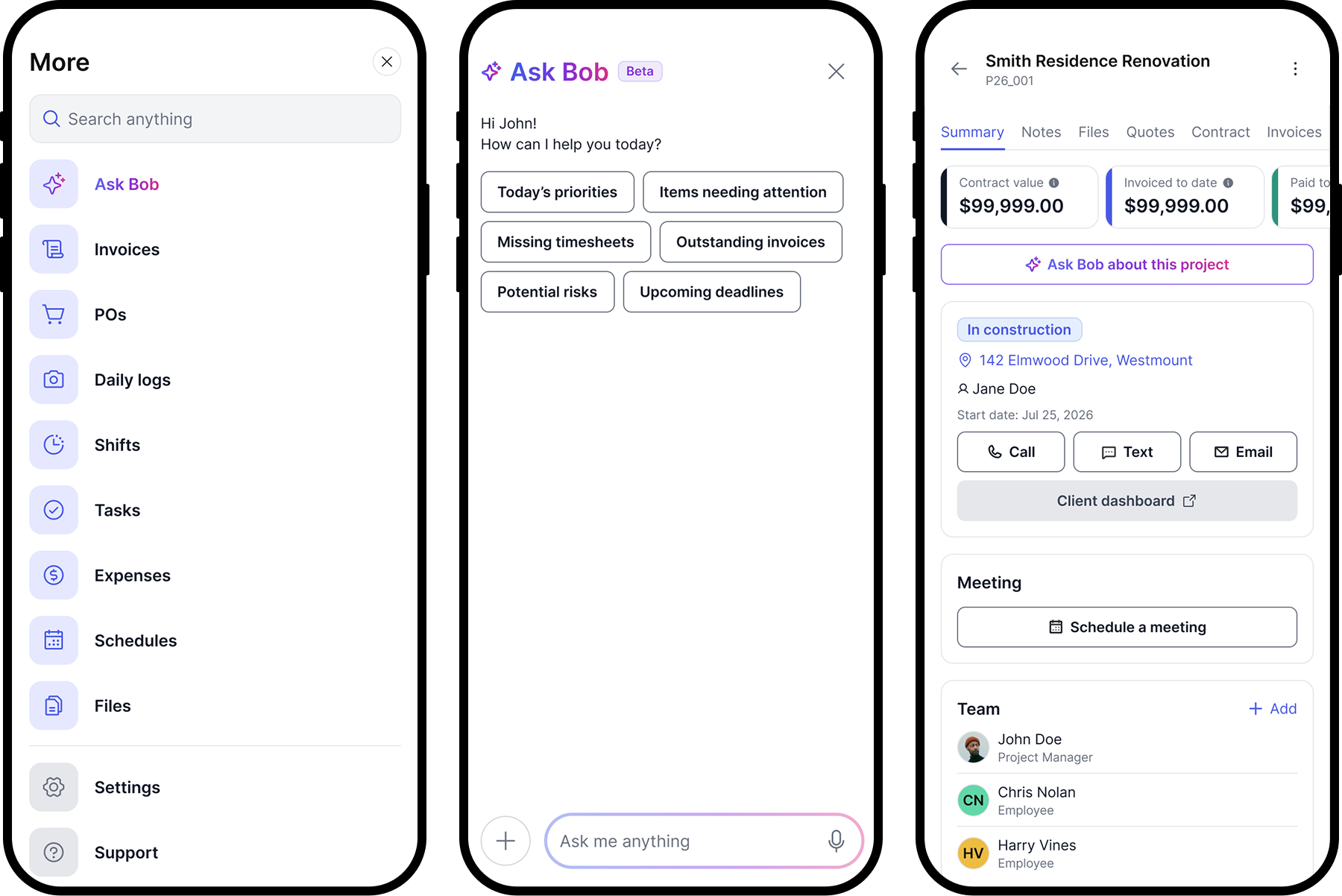
Same AI team, same Routines, right in your pocket: ask Bob a question from the truck, or pull up a job's full status without opening a laptop.
You did not get into construction to spend your evenings reviewing dashboards, building estimates from scratch, and chasing leads that came in after hours.
The agentic AI era is not about replacing your judgment. You still run the jobs. You still manage the relationships. You still make the calls that matter. What changes is everything around that. The estimates. The monitoring. The lead handling. The follow-ups. The reports.
That is the work that has always been there, always needed doing, and has always eaten time you did not have. Billdr is the harness that finally takes it off your plate.